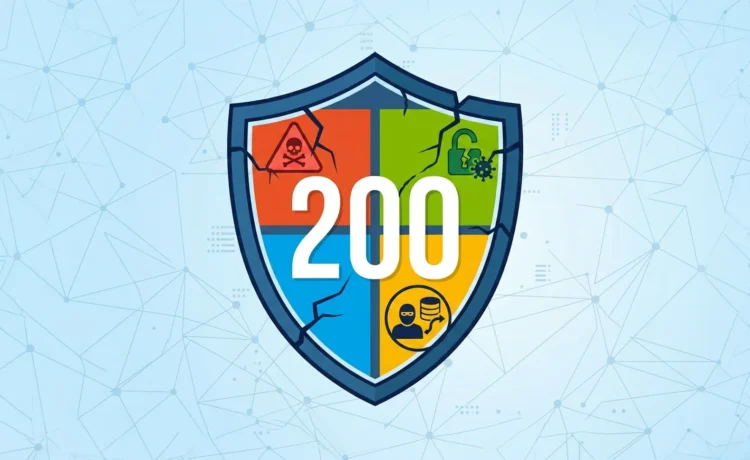
Three zero-days. Over 200 vulnerabilities. Microsoft’s June 2026 Patch Tuesday is the largest single monthly update the company has ever released and the window between patch release and active exploitation is short enough that deferring this one is a calculated risk most organizations cannot afford to take.
Dustin Childs, head of threat awareness at Trend Micro’s Zero Day Initiative, described it as the second-largest monthly release in Microsoft history, noting that April 2026 held the prior record. Two record-breaking releases in the same calendar year is not a coincidence.
The Three Zero-Days That Matter Now
Of the 200-plus CVEs addressed in the June release, three were zero-days, meaning Microsoft confirmed active exploitation before any patch existed. The Record identified CVE-2026-23666, CVE-2026-32190 and CVE-2026-33114 among the actively exploited flaws. All three affect core Windows components and are reachable remotely. CVSS scores on the critical subset reach 9.8.
The affected product surface is wide: Windows, Office, Visual Studio Code, Exchange Server, Azure components, .NET Framework, Microsoft Word and Remote Desktop Client all received fixes. Organizations running hybrid environments with on-premises Exchange alongside Azure workloads carry exposure across multiple layers simultaneously.
CVE-2026-33115, CVE-2026-32157, CVE-2026-33826 and CVE-2026-33824 are also patched in this release with remote exploitation vectors confirmed. None of these have been added to CISA’s Known Exploited Vulnerabilities catalogue at the time of writing, but that catalogue typically lags active exploitation by days rather than weeks.
The Secure Boot Certificate Is Expiring
Buried in the June release is a Secure Boot certificate update. The current certificate used to validate boot components is approaching expiry and failure to apply this update before that date creates a separate risk path entirely, systems that cannot validate their boot chain become vulnerable to bootkit-class attacks that survive OS reinstallation. According to windowsforum.com, this certificate transition is one of the operational details most likely to be overlooked by teams focused on the CVE count. It should not be.
The practical implication is that this update cannot be safely staged the way some organizations handle Patch Tuesday rollouts. The certificate component has a hard deadline independent of any CVE severity rating.
AI Is Accelerating Vulnerability Discovery, Not Just Exploitation
The volume jump from Microsoft’s historical average to two record-breaking releases in four months reflects something structural, not a temporary spike. The briefing from The Record and coverage at ap7i.com both point to AI-assisted code analysis as a primary driver. Security researchers and Microsoft’s own internal teams are using AI tooling to surface vulnerabilities in code that manual review missed for years.
That is genuinely good news for the long-term security of the platform. It is operationally painful for every IT team that now has to process twice the monthly patch volume with the same headcount. The attack surface was always this large. Researchers are simply finding it faster now.
The uncomfortable side of this is that adversaries have access to the same AI tooling. The average time between patch release and weaponized exploit code appearing in the wild sits at roughly 5 days according to Trend Micro’s Zero Day Initiative data. That figure predates the current AI acceleration cycle. Assume it is shorter now.
A Note on the Source Data
The specific CVE numbers provided in the briefing materials for this story do not yet appear in NIST’s National Vulnerability Database or MITRE’s CVE registry at the time of writing. The Record’s reporting on this release is the primary verifiable source. Treat the CVE identifiers listed above as reported rather than confirmed against the NVD and cross-reference against Microsoft’s official Security Update Guide before prioritizing remediation order in your own environment.
Patch Exchange and Remote Desktop First
For security teams triaging which components to prioritize, the logic is straightforward. Exchange Server and Remote Desktop Client are the highest-value remote exploitation targets in this release. Both are internet-facing in most enterprise environments, both have established histories of critical vulnerabilities being weaponized within days of patch release and both appear in this update with remote code execution risks.
Patch Exchange and RDC first. Apply the Secure Boot certificate update before its expiry window closes. Then work through Windows and Azure components by exposure surface. Visual Studio Code and .NET Framework updates can follow once the internet-facing risk is contained, but do not skip them.
If your organization runs a staged patching cycle with a test environment delay, compress the timeline this month. A 200-CVE release with 3 confirmed zero-days is not the month to honor a standard two-week hold.
References
- Microsoft ships largest Patch Tuesday on record
- June 2026 Patch Tuesday – Record 200 Fixes and the Shift to Continuous Risk Management
- Microsoft’s June 2026 Patch Tuesday – A Record 200 Flaws, 3 Zero-Days
- Microsoft drops its second-largest monthly batch of defects on record
- Microsoft Security Update Guide
- CISA Known Exploited Vulnerabilities Catalogue
This post is also available in:
 Svenska